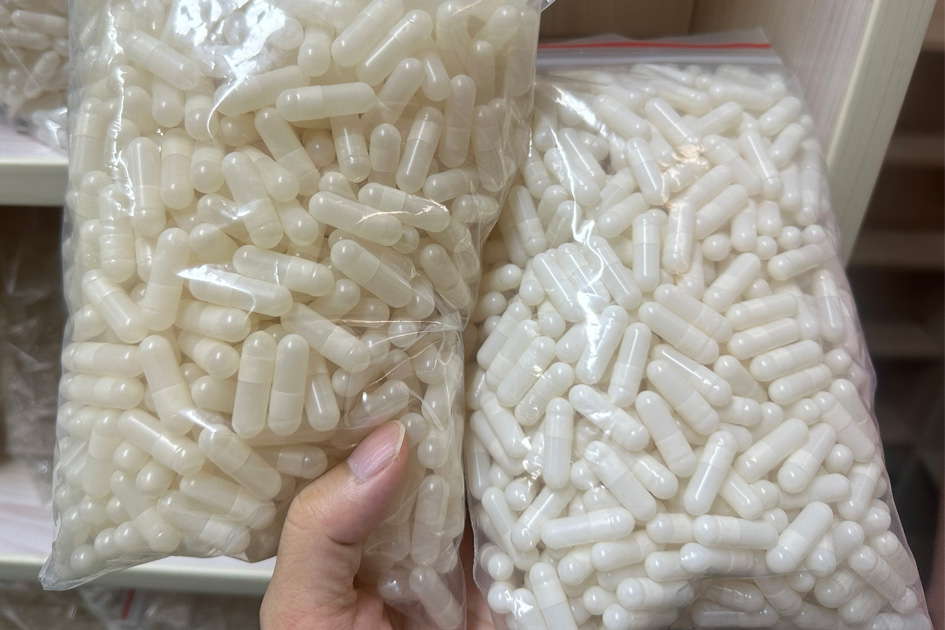
By Dongguan Yidikou Medical Tech Co.,Ltd. | Empty Capsule Shell Solutions
When sourcing empty capsule shells, buyers often focus on gelatine or HPMC grades, dimensions, and color options. But there is another formulation detail that can quietly affect shell appearance, stability, and even regulatory compliance: the choice of whitening agent.
Two names frequently appear in supplier discussions: zinc white and calcium white. They sound similar. They both produce a white shade. But chemically, they are entirely different materials with different performance profiles. For capsule shell manufacturers and brand owners, understanding the distinction is not academic—it is practical quality control.
What Is Zinc White?
Zinc white is the common trade name for zinc oxide (ZnO) . It is a fine white powder with a long history in pigments, rubber, and pharmaceutical preparations. In capsule shell formulations, zinc oxide can contribute opacity and a bright, cool white tone.
Technically, zinc oxide is amphoteric—it dissolves in both acids and strong alkalis . Its density is relatively high (around 5.6 g/cm³), and it has a refractive index near 2.0, which helps explain its hiding power in thin films . For capsule shells, where the film thickness is measured in tenths of a millimeter, that refractive index matters: it means less material can achieve more whiteness.
However, zinc white is not inert in every environment. It reacts with acids, and under certain conditions it can interact with other formulation ingredients. This is not necessarily a defect—but it does mean that compatibility testing is essential when zinc white is used in a capsule shell that will contain acidic fill materials.
What Is Calcium White?
“Calcium white” is a looser term. In industrial pigment and filler contexts, it most often refers to calcium carbonate (CaCO₃) derived from chalk, limestone, or precipitated calcium carbonate . Unlike zinc white, calcium carbonate is an alkaline mineral. It reacts readily with acids, producing carbon dioxide gas—a fact that any formulator can verify with a drop of vinegar .
As a whitening agent, calcium carbonate is widely used as a filler and extender. It brightens and opacifies at low cost, but its refractive index is lower than that of zinc oxide, and its covering power per unit weight is correspondingly weaker . In capsule shells, calcium carbonate can contribute whiteness and body, but it also introduces a material that is chemically basic and acid-reactive.
That reactivity is not automatically disqualifying. Many capsule formulations are designed with compatible fill chemistries. But if the capsule is intended for an acidic active ingredient, or for a product with moisture sensitivity, the acid-carbonate reaction pathway deserves attention during stability testing.
The Practical Difference for Capsule Shell Buyers
For procurement and quality teams, the zinc white versus calcium white question usually reduces to three decision points:
1. Opacity and appearance. Zinc white offers higher refractive index and stronger hiding power. If the goal is a visually dense, bright white capsule shell with minimal pigment loading, zinc white has a technical edge. Calcium white is a competent brightener but typically requires higher loading to match the same degree of whiteness.
2. Chemical compatibility. Calcium carbonate reacts with acids. Zinc oxide reacts with acids and alkalis. Neither is universally “safe” for every fill formulation. The right choice depends on what goes inside the capsule, not just what the shell looks like on the outside.
3. Regulatory and labeling considerations. In some markets, calcium carbonate is treated as a conventional food additive or filler. Zinc oxide, while also used in pharmaceutical and food contexts, may carry different labeling or usage-limit requirements depending on the jurisdiction and the product classification. Buyers should confirm that the whitening agent used in their capsule shells meets the regulatory pathway of the final market.
A Note on Terminology
The term “calcium white” is not a standardized chemical name in the way that “zinc white” is. Suppliers may use it to refer to calcium carbonate, to surface-treated calcium carbonate, or occasionally to other calcium-based white powders. When reviewing a specification sheet, do not stop at the trade name. Ask for the CAS number and the exact chemical identity. For zinc white, the CAS is 1314-13-2. For calcium carbonate, it is typically 471-34-1. A legitimate supplier will provide this without hesitation.
How We Approach Whitening Agents at Yidikou Medical Tech
At Dongguan Yidikou Medical Tech Co.,Ltd, we manufacture empty capsule shells in a range of opacity and color options. We do not treat whitening agents as a commodity afterthought. Every pigment or opacifier we use is selected for compatibility with the shell polymer system, validated for appearance consistency batch to batch, and documented for regulatory review.
If your product requires a specific whitening system—or if you need guidance on which agent is appropriate for your fill formulation—our technical team is available to discuss your requirements. We would rather have that conversation before the order than after the stability chamber has spoken.
Contact us to request samples, specifications, or a technical consultation on capsule shell formulation.
Dongguan Yidikou Medical Tech Co.,Ltd. manufactures empty capsule shells for nutraceutical, pharmaceutical, and food applications. This article is intended for informational purposes and does not constitute regulatory or formulation advice for any specific product.
发表回复